Agent-Fi - Financial Reports Portal
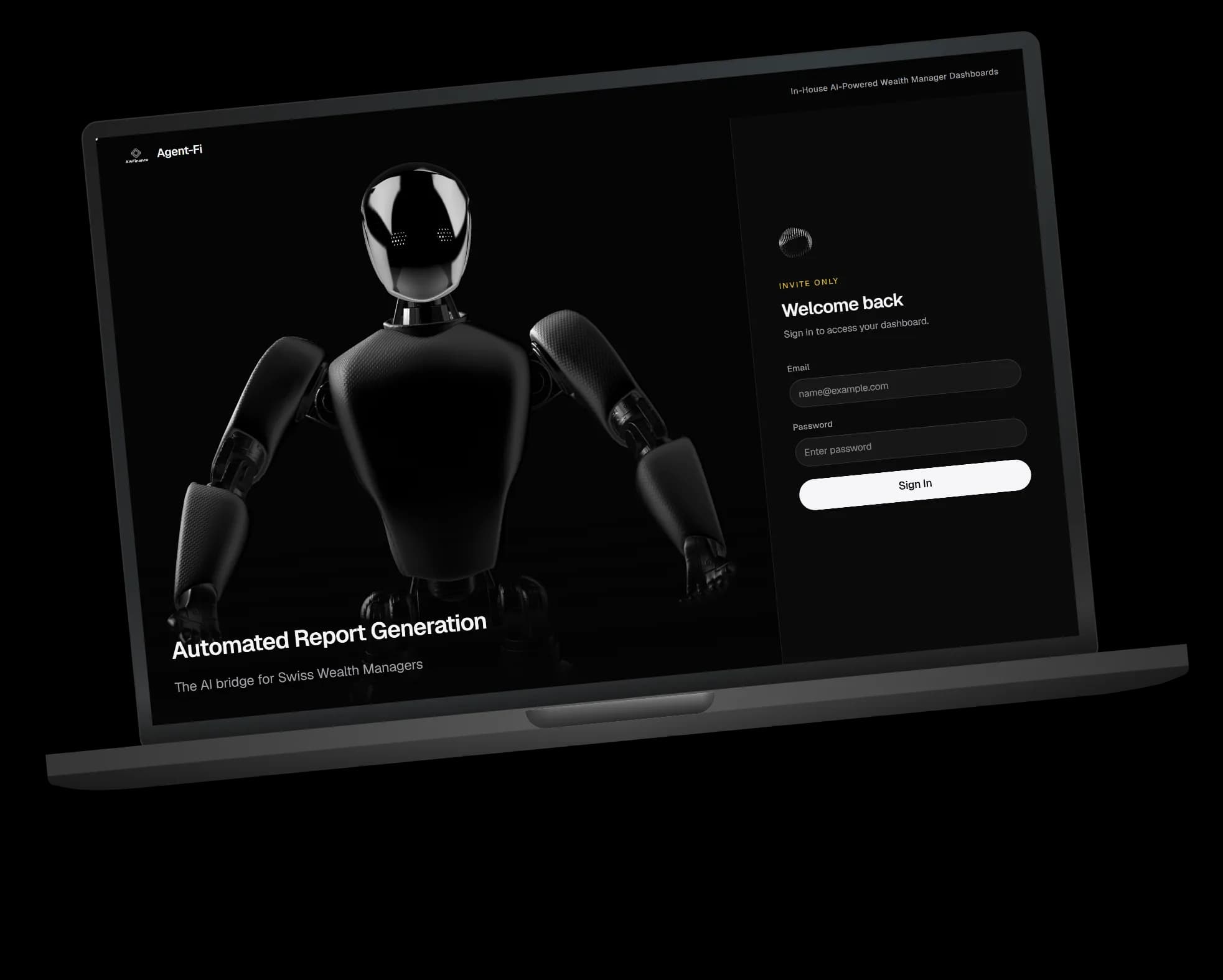
Agent-Fi produces financial research reports for wealth managers. The project involved designing and building the private portal that delivers them: an invite-only space with no public sign-up, where the administrator uploads reports and each client sees only the ones meant for them, organised by asset class, in a restrained interface inspired by private banking.
Context
Objectives
- Deliver confidential financial research reports to wealth managers without relying on email or attachments.
- Guarantee strictly private access: invite-only sign-in, no public registration, and an isolated space for each client.
- Let the administrator publish, organise and remove reports independently, without any technical help.
My role
- UI Design: creation of a dark design system with gold accents, inspired by private banking, with components and tokens shared across the whole portal.
- Full-stack Development: architecture, authentication, database, file storage and deployment.
Process
Research & Inspiration
- Reuse of the sign-in screen from the client's existing research tool, logo, 3D scene and taglines, to keep visual continuity, with the rest of the portal designed from scratch.
- Visual direction inspired by Apple interfaces and private banking: near-black background, Geist typeface, gold accent and subtle animations.
Feature Definition
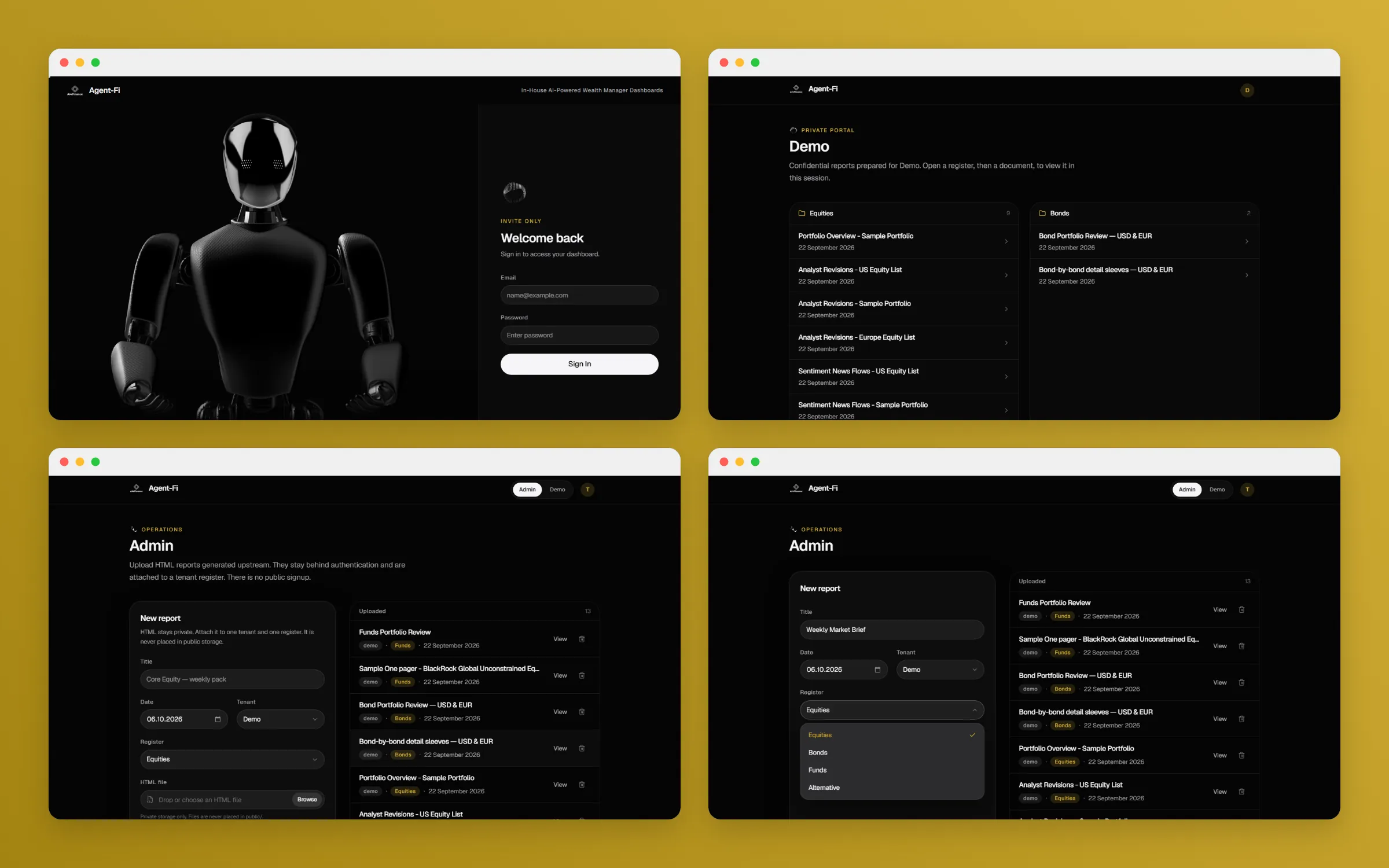
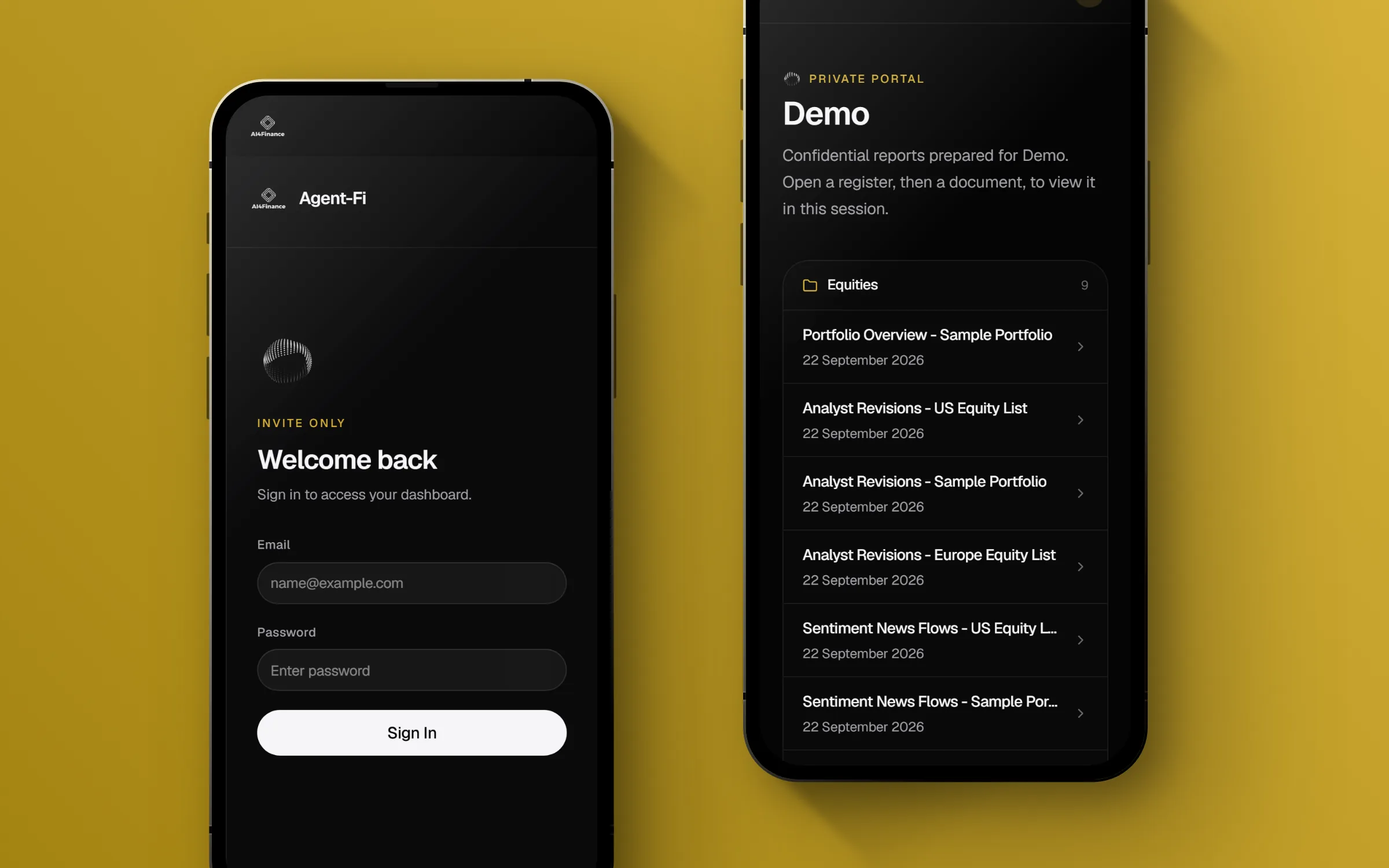
- Invite-only sign-in: accounts are created by the administrator, with no registration or password recovery page.
- Multi-client architecture: each wealth manager only reaches their own space, while the administrator can access every portal.
- Reports organised into four registers by asset class: equities, bonds, funds and alternative investments.
- Admin area to upload, date, categorise and delete reports.
- Built-in report viewer, displaying each document in an isolated frame after checking the session and access rights.
- Dedicated demo space, used to present the portal to prospects.
Development
- Built with Next.js (App Router), React, TypeScript and Tailwind CSS, deployed on Vercel.
- Authentication through a signed session cookie (httpOnly JWT via jose) and bcrypt-hashed passwords, with centralised access control that routes each role to its own space.
- Postgres database hosted on Neon, limited to accounts, clients and metadata: reports are kept separately in private object storage (Vercel Blob), never in the database or in public files.
- Reports served through an authenticated route and rendered in a sandboxed iframe, isolating their content from the rest of the application.
- Interface built on accessible Radix UI primitives, with Motion animations and a Spline 3D scene on the sign-in screen.
- Non-technical architecture document written for the client, explaining the role of each building block: domain, hosting, database and storage.
Conclusion
Challenges
- Enforcing isolation between clients at every level, routing, pages and file access, so that no report can be reached outside the space it belongs to.
- Making report display reliable in production: since the serverless host's file system is ephemeral, files moved to private object storage, with the document loaded before display and an explicit message when a file is missing, rather than an empty frame.
- Evolving a flat list of reports into four asset-class registers without disrupting documents already published.
Results & Learnings
- Portal live in production, invite-only, supporting the full flow of publishing and reading confidential reports.
- Multi-client architecture ready to onboard new wealth managers without further development.
- Skill development in securing a Next.js application: signed sessions, role-based access control and private file delivery.
A business tool or an app to build?
Tell me about your needs in a few lines and I'll get back to you with a first approach.