TPG Go - Next Departures for Geneva Public Transport
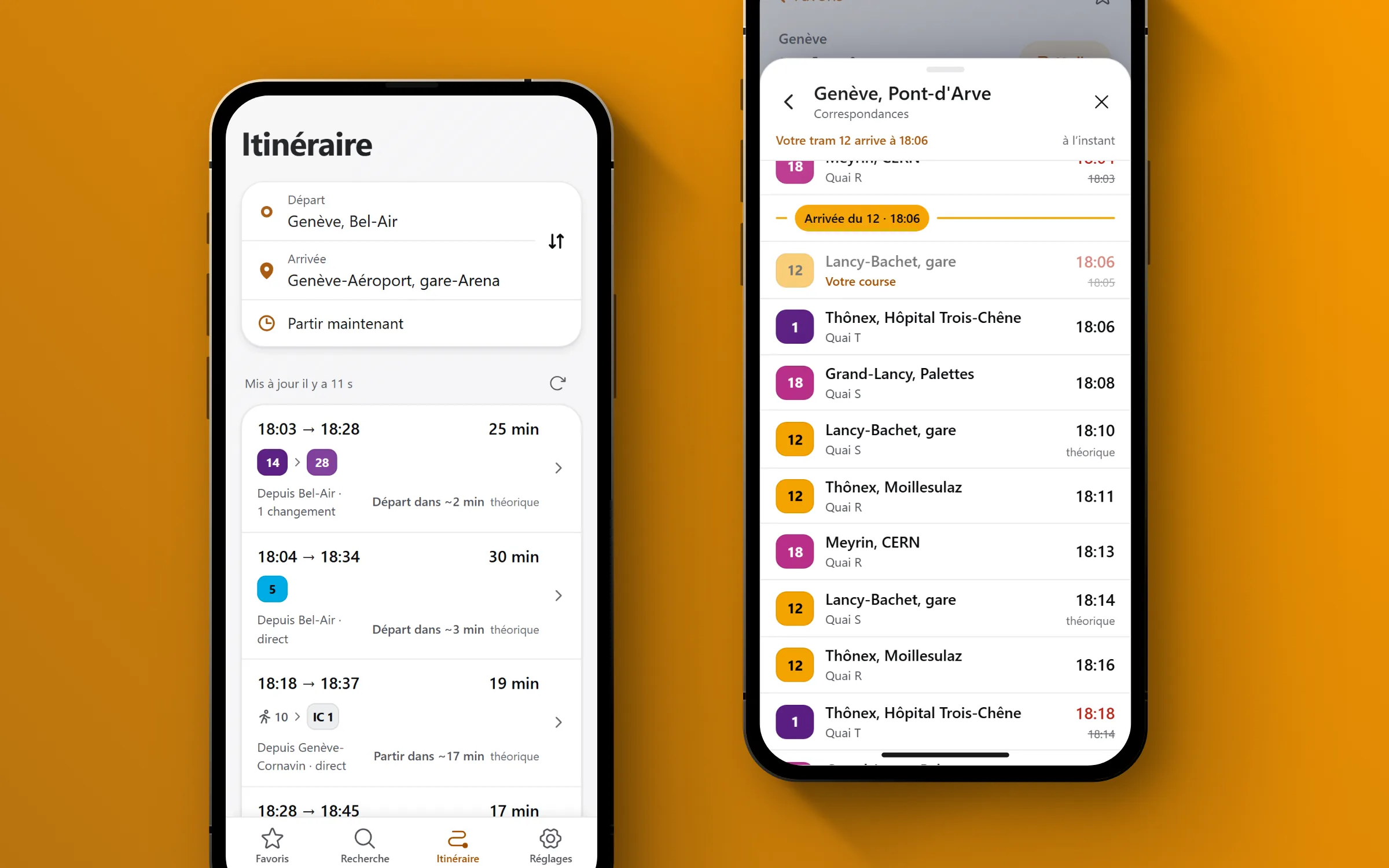
TPG Go is a personal project. People around me were not convinced by the new official TPG app, so I designed and built an alternative focused on the essentials. This installable PWA shows the next departures at a stop in real time, keeps favourites within reach, plans journeys and lets you follow a trip stop by stop. It works without an account or cookies, and the device's location is never sent to the server.
Context
Objectives
- Show the next departures at a TPG stop in real time, readable at a glance, with the scheduled time clearly marked as such when real-time data is missing.
- Offer friends and family an alternative to the new official app, focused on favourites, stop search and journey planning.
- Protect privacy: no account, no cookies, and a location that stays on the device.
- Stay free to host: deployed on Vercel's free tier, built on open transport data.
My role
- UI Design: creation of a restrained design system inspired by Apple's HIG, with light and dark themes, a TPG orange accent, four elevation levels and touch targets of at least 44 px.
- Full-stack Development: architecture, server routes, use of open transport data, PWA and deployment.
Process
Research & Inspiration
- Visual direction inspired by Apple's HIG: flat background with no orbs or decorative effects, a theme that follows the system or can be forced in Settings, and a TPG orange accent.
- Review of open data sources: the community API transport.opendata.ch for departures and journeys, and the official GTFS from opentransportdata.swiss for stops and line colours.
- GTFS-RT is ruled out: it publishes no vehicle positions and would require a timetable engine of our own. The official OJP 2.0 API is kept as a lead for a v2.
Feature Definition
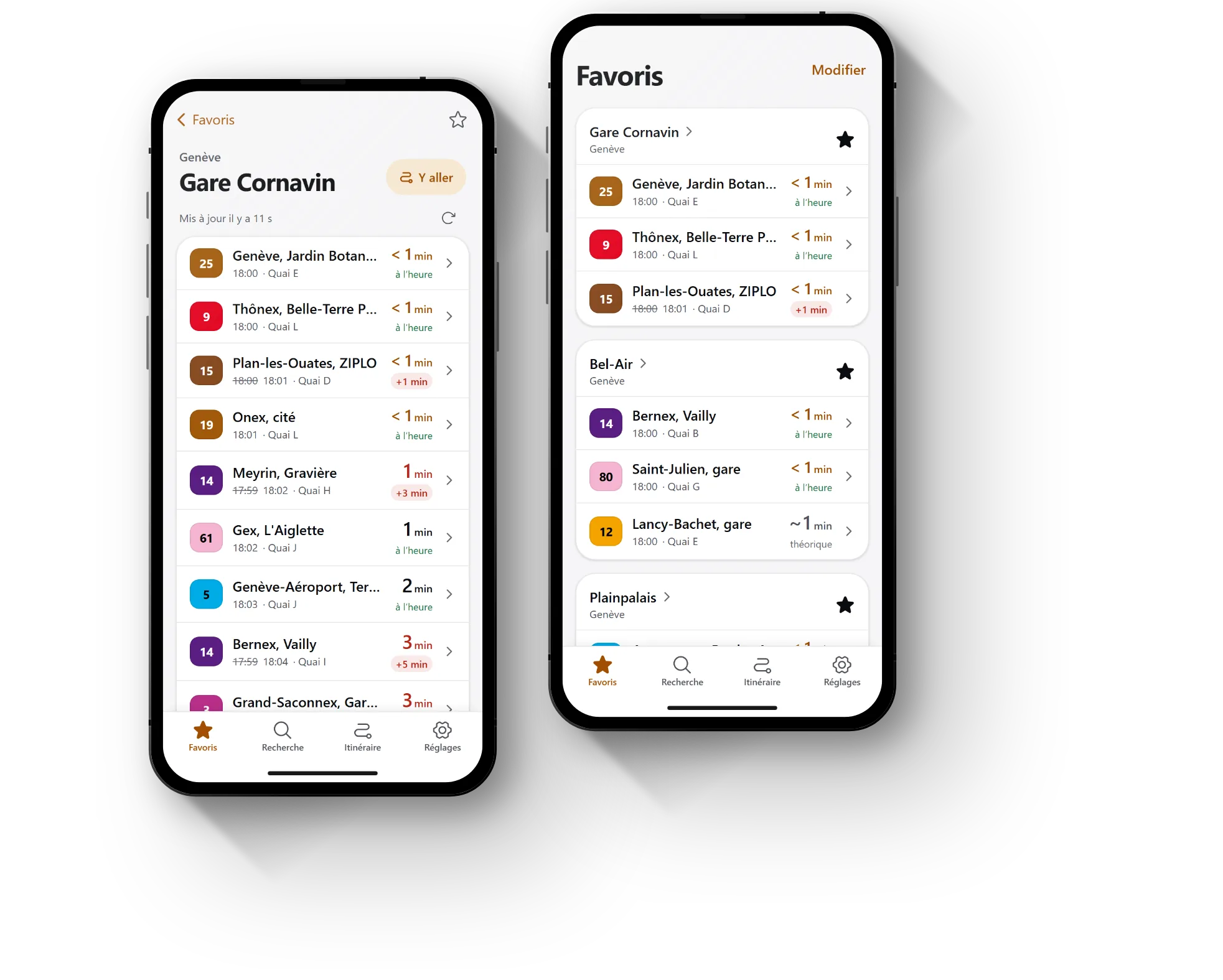
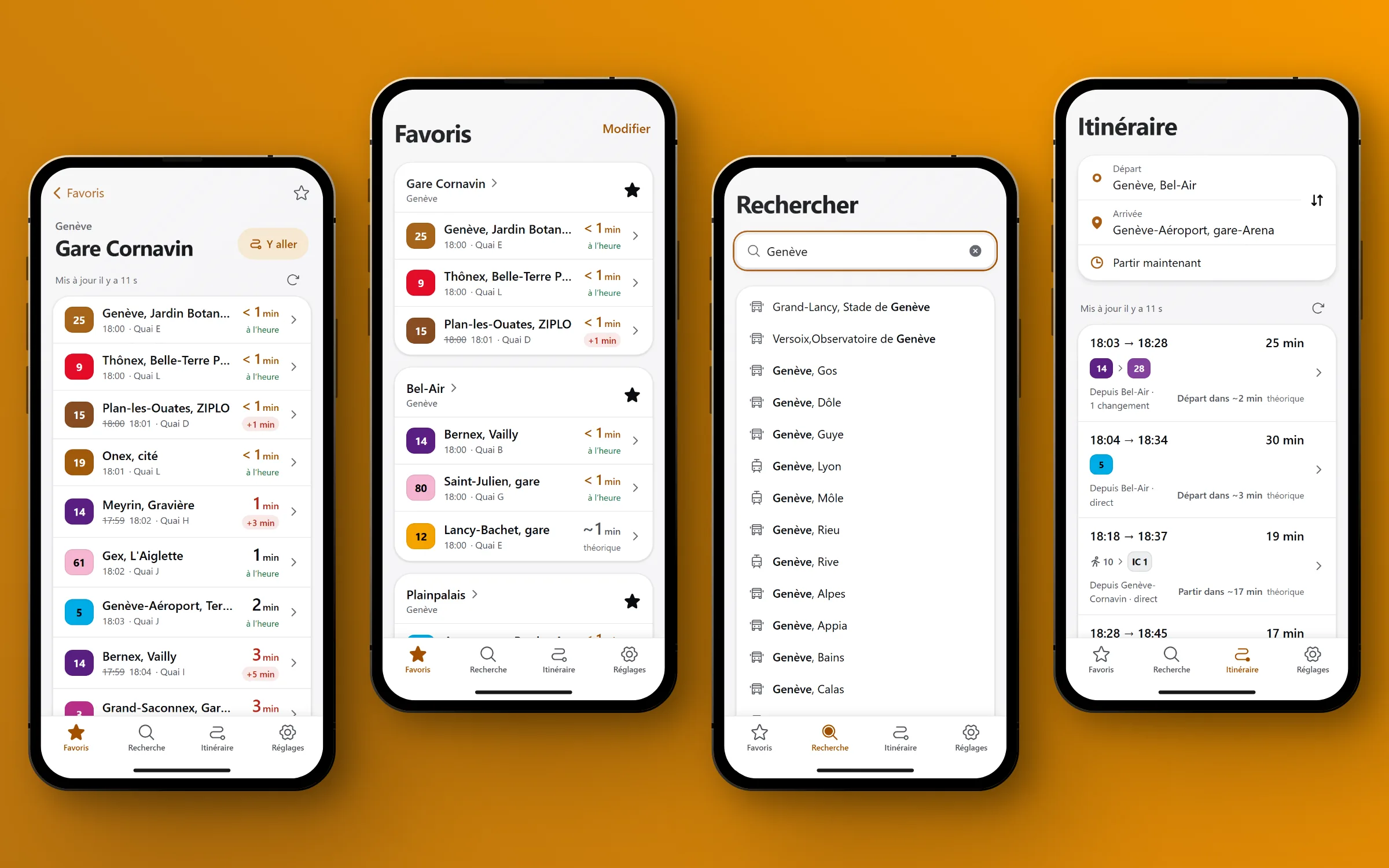
- Favourites on the home screen, each showing the next three departures of its stop, and reorderable.
- Stop search with autocomplete limited to the TPG network, insensitive to accents and punctuation, complemented by recent and nearby stops.
- Stop board: line badge in its real colours, destination, countdown and real-time delay.
- Trip tracking: the remaining stops of a journey, with progress inferred from the timetable.
- Journeys from a stop or from the device's location, either immediate or planned up to 30 days ahead, by picking a departure or arrival time.
- Settings: theme, a suggestion form forwarded to a Discord channel, and the privacy policy.
Development
- Built with Next.js 15 (App Router), React 19, strict TypeScript and Tailwind CSS 4, deployed on Vercel.
- Installable PWA: the service worker serves the app shell offline and never caches departures.
- Every data call goes through server routes and a single typed layer that isolates the third-party source from the rest of the app. A server cache of about 20 seconds for departures spares the shared API, and the screen refreshes every 30 seconds, or every 15 seconds when a departure is close.
- A local index of about 880 TPG stops and the line colours are generated by scripts from the official GTFS. Colours missing from the file come from the TPG website, with sourced manual corrections and contrast recalculated to keep text readable.
- Abuse-protected suggestion form and a privacy page describing each piece of data processed (Swiss FADP and GDPR).
Conclusion
Challenges
- Making stop search reliable: the source's search mixes the whole of Switzerland and caps results at ten, which made Geneva stops disappear. Replaced by a local index of the stops served by TPG, built by streaming the GTFS rather than downloading the full archive.
- Offering "nearby" stops and journeys from the user's location without sending it: distances are computed on the device, and the server only receives nearby stop identifiers and walking minutes.
- Showing only what the source provides: no public source gives vehicle positions, so a trip's progress is inferred from the timetable and the interface says so.
- Handling real-time edge cases: stale departures after a period of inactivity, an incomplete offline shell, and a one-hour shift in the source on the day the clocks change, fixed by computing the offset from the time zone rather than from a hard-coded date.
Results & Learnings
- App live and installable on mobile, with favourites, search, journey planning and trip tracking.
- Features shaped by feedback: planning a trip for a chosen date and time came from a user suggestion, collected through the form built into the app.
- Data source isolated behind a single layer, which will make it possible to test OJP 2.0 for finer-than-a-minute times and cancelled-trip reporting without touching the interface.
- Skill development in working with open data (GTFS), PWAs, and handling time zones and clock changes.
Live website
A business tool or an app to build?
Tell me about your needs in a few lines and I'll get back to you with a first approach.